
There are a several interconnected variables that affect canine shoulder angulation, some are related to structural flaws (bone length discrepancy) while others are related to postural flaws (muscle imbalances). And, sometimes it can be hard to tell which is which. Learn how to assess your dog’s shoulder angulation, which structural or postural deviation they have, and if there are targeted conditioning exercises that can help!
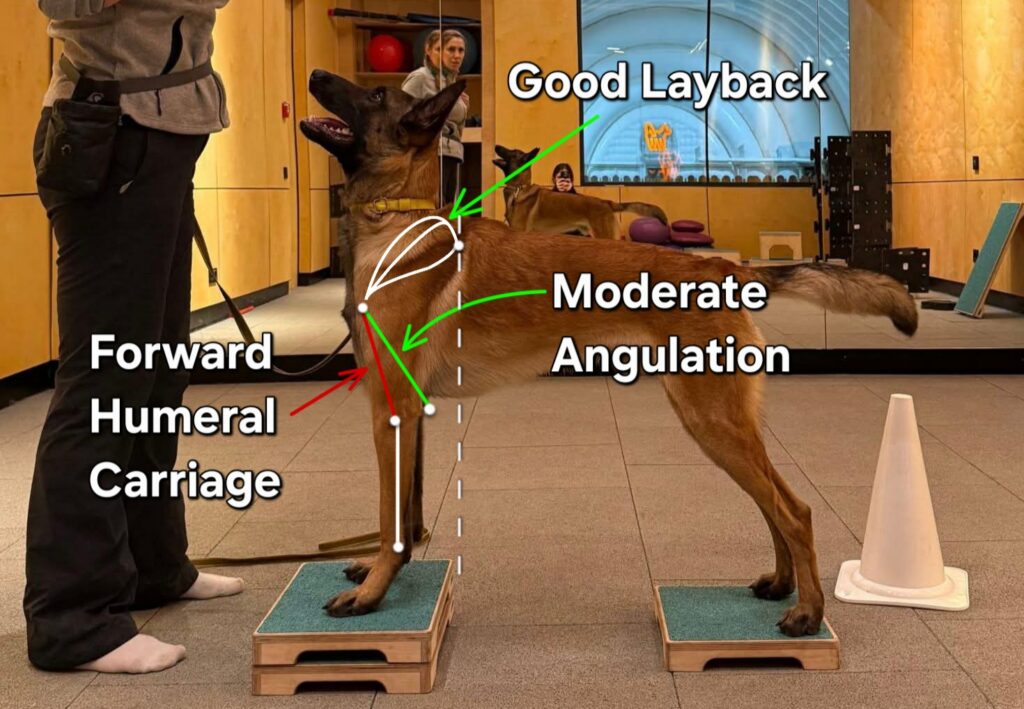
Canine shoulder angulation is governed by two main components
Structure: Bone length and shape
Posture: Muscle balance and tone
The structure of the canine shoulder is determined by the length and shape of the scapula (shoulder blade) compared to the length and shape of the humerus (upper arm). When these two bones are even in length, the shoulder complex is able to move efficiently during acceleration and deceleration, is able to effectively absorb ground reaction force (impact force), and has appropriate bony structure for the balanced development of muscle through all three shoulder chains.
Structure is a static variable, is determined by genetics and cannot be changed.
Posture of the canine shoulder is determined by the balance of muscle tone between muscle pairs (agonist and antagonist), and balance between muscle chains.
Posture is plastic and is heavily influenced by muscle tone (tension held within the muscle), strength, and mobility of all the muscles surrounding the bone(s) that work together to hold it in place. This means we can use targeted conditioning exercises to influence alignment of the shoulder complex, improving movement quality and reducing injury risk. Pretty neat!!
—
How to ACCURATELY Assess the Canine Shoulder
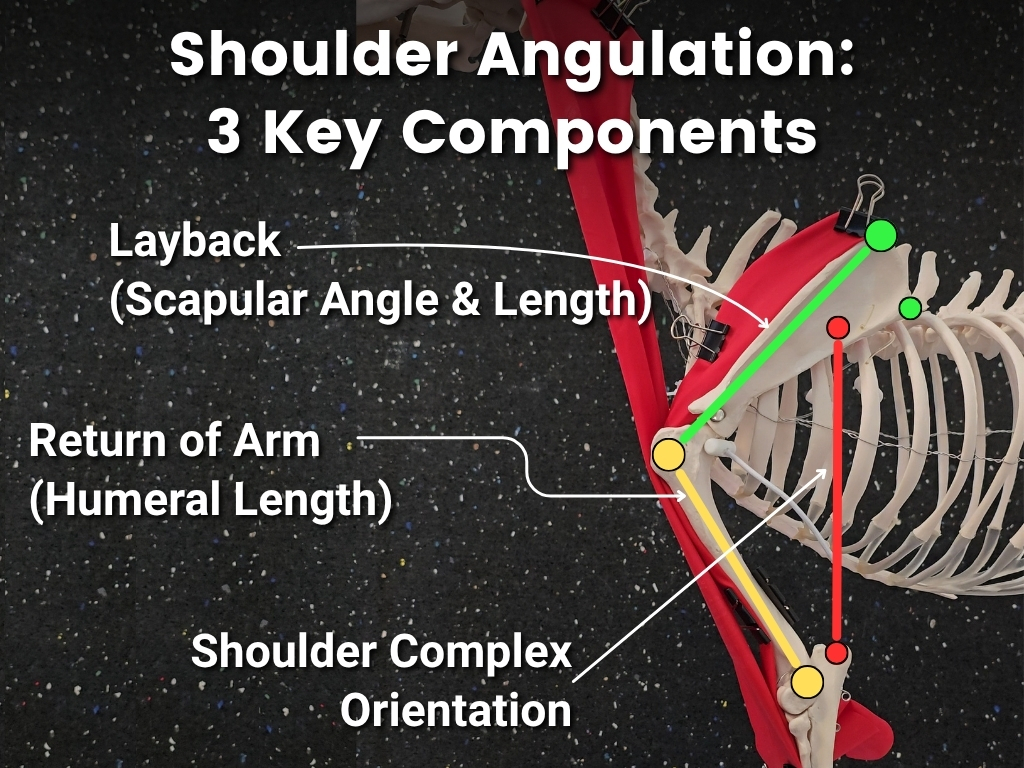
When assessing canine shoulder angulation, we are looking at three key components
Layback: Length and angle of the scapula
Return of Arm: Length and angle of the humerus
Orientation: Position of the scapula, humerus, and antebrachium (Iower forelimb) in relationship to each other.
Assessing these three components will tell us if the individual dog’s shoulder angulation is correct or incorrect. And if a deviation is present, if the deviation is structural (related to bone length and unable to be changed) or postural (able to be improved via targeted conditioning exercises).
—
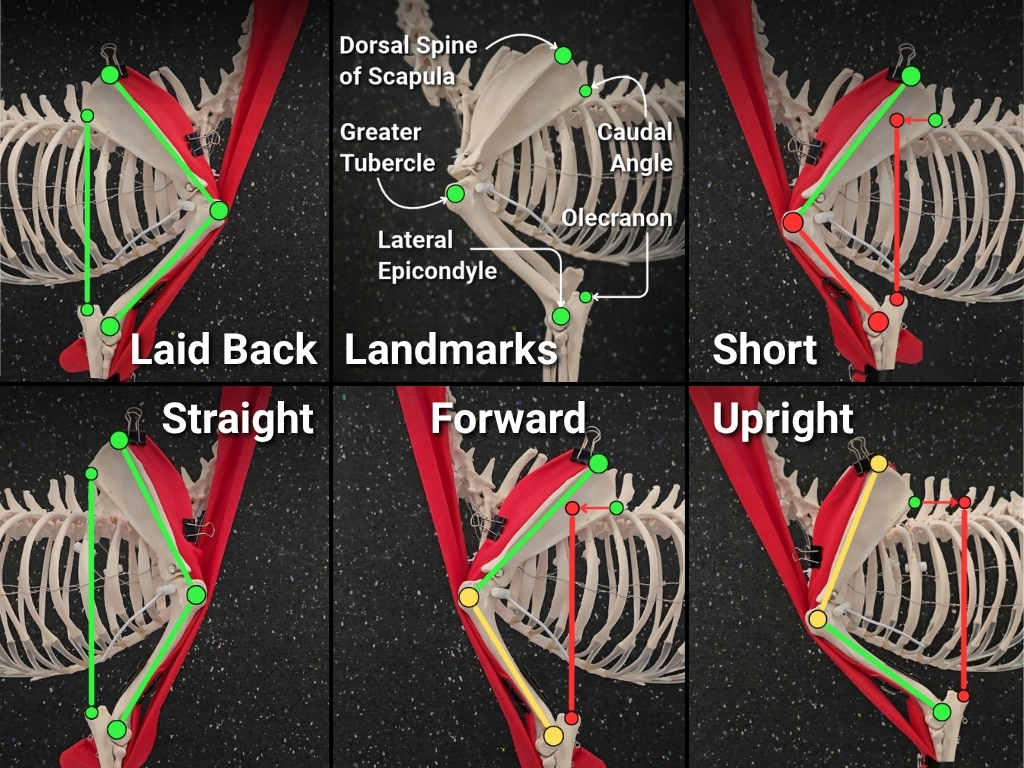
Step 1: Find the Bony Landmarks
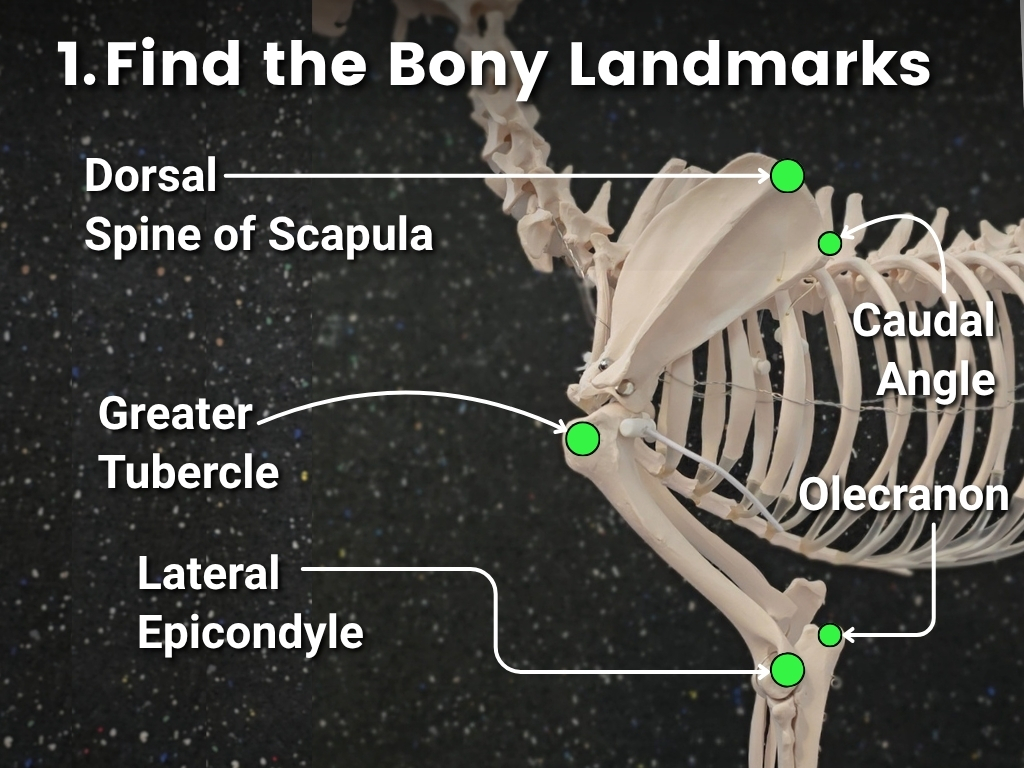
Dorsal Spine of Scapula: Palpating the scapula, find the bonny ridge that bisects the scapula. This is the spine of scapula. Follow the spine of scapula upward to where the scapula ends.
Greater Tubercle: Follow the spine of scapula downward, past the hamatus process at the front of the scapula, to the knobby bump on the craniolateral aspect (front + side) of the humerus.
Lateral Epicondyle: Follow the humerus downward to the knobby bump on the lateral aspect of the elbow.
NOTE: The lateral epicondyle is on the side of the elbow immediately above the carpus. NOT at the back of the elbow.
Caudal Angle: From the dorsal spine of scapula, follow the rim of the scapula backward until you feel the back corner.
Olecranon: From the lateral epicondyle, move your hand backward to find the sharp bone at the back of the elbow.
—
Step 2: Measure Bone Length & Orientation
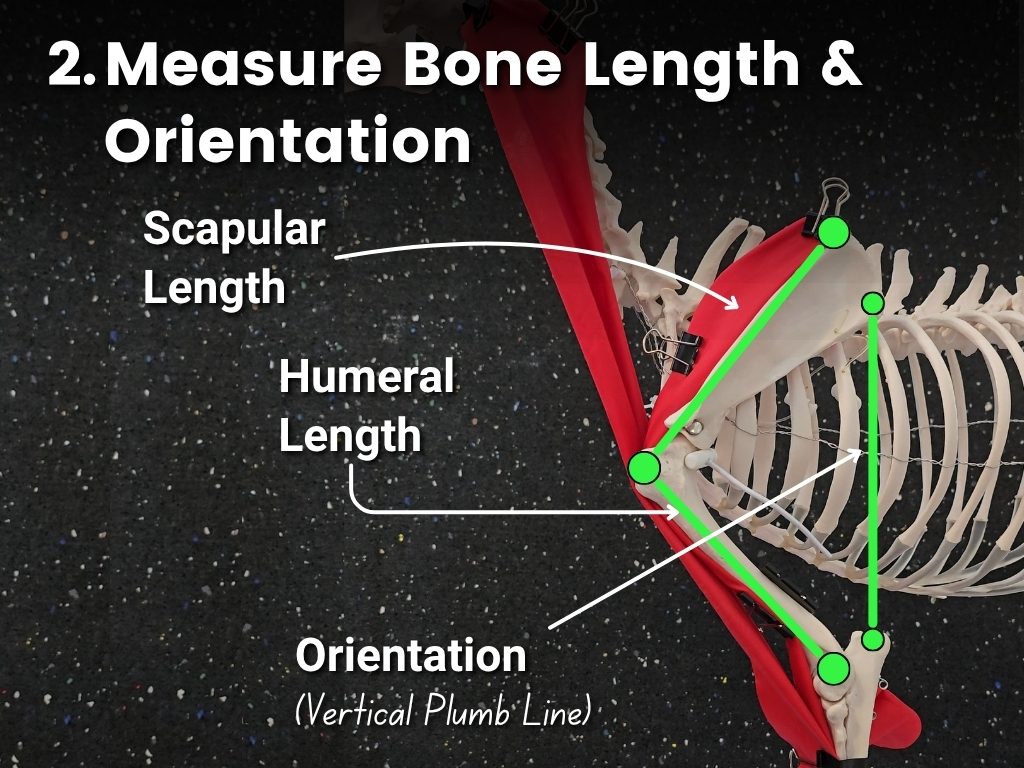
To find the Scapular Length, measure from the dorsal spine of scapula to the greater tubercle.
To find the Humeral Length, measure from the greater tubercle to the lateral epicondyle.
To find the Orientation, draw a straight line upward from the olecranon.
—
Step 3: Assessing Structure vs Posture
Well Laidback Shoulders
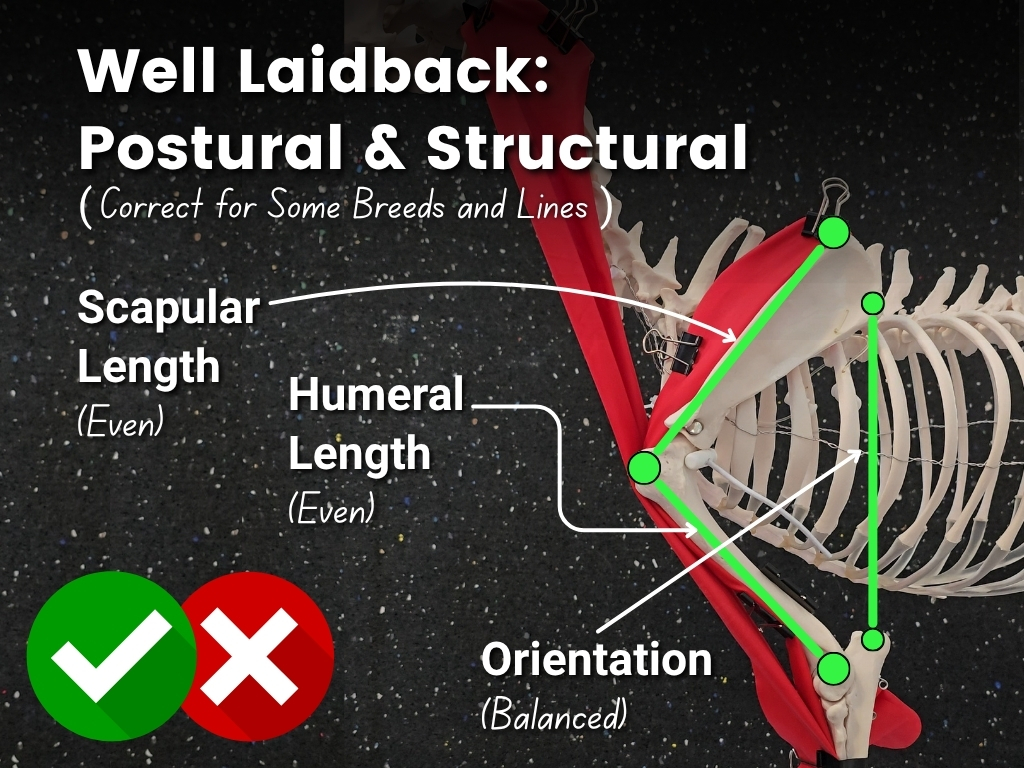
Characteristics:
- Even length between the scapula and humerus
- Spine of scapula following a 35-45° angle
- Balanced orientation
- Caudal angle is oriented vertically above the olecranon.
This is an example of correct canine shoulder angulation, and is caused by even bone length (structure), and balance in muscle tone between the muscles in the…
Dorsal Scapular Chain: trapezius, rhomboid, serratus ventralis
Cranial Shoulder Chain: brachiocephalicus, supraspinatus, and biceps
Caudal Shoulder Chain: teres major, deltoid, triceps
—
Straight Shoulders
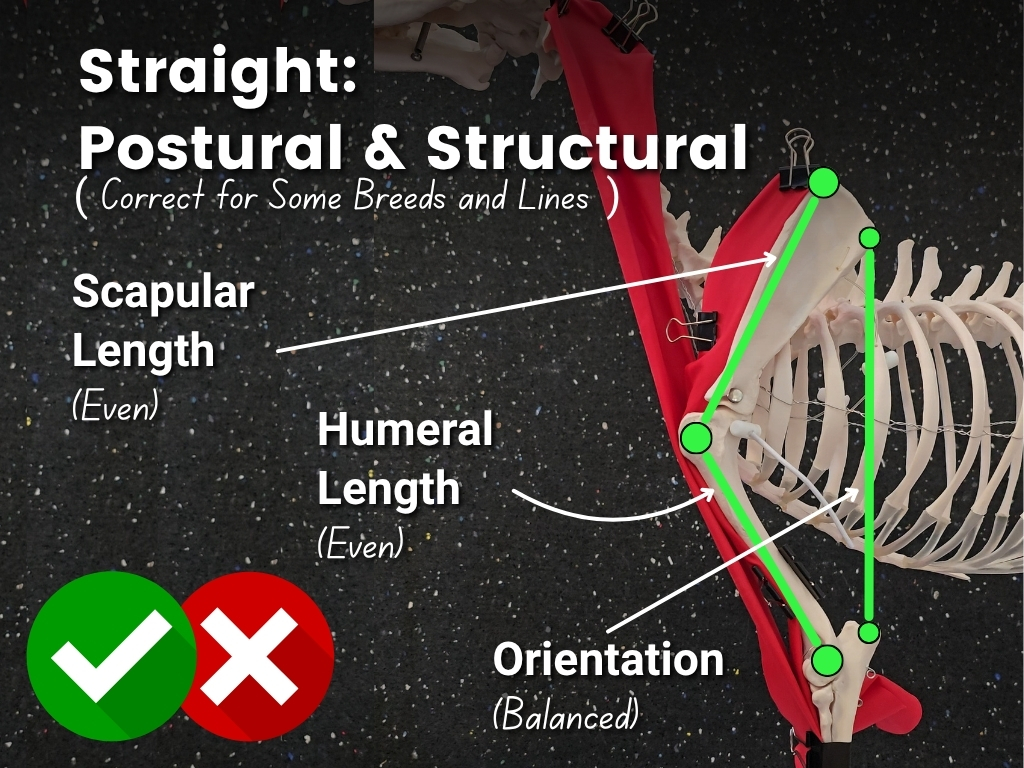
Characteristics:
- Even length between the scapula and humerus
- Spine of scapula following < 35° angle
- Balanced orientation
- Caudal angle is oriented vertically above the olecranon.
This is another example of correct canine shoulder angulation, and is caused by even bone length, coupled with additional tone in the dorsal and cranial chains. This additional tone provides a mechanical advantage for sprinting breeds (like sighthounds), and allows these breeds to take advantage of mechanical “snap back” when moving at top speed, which uses zero metabolic fuel and zero oxygen.
—
Forward Humeral Carriage
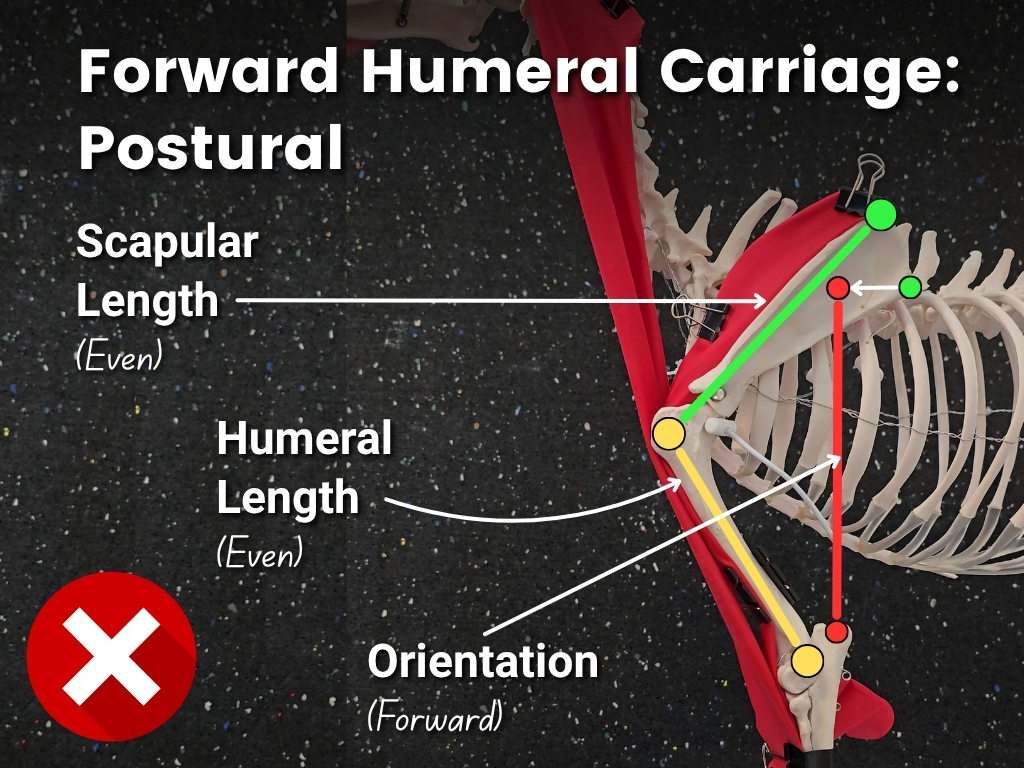
Characteristics:
- Even length between the scapula and humerus
- Unbalanced orientation
- Olecranon is oriented forward of the caudal angle
This is an example of incorrect canine shoulder angulation caused by tightness in the cranial chain coupled with weakness in the caudal chain, which allows the humerus to be seated forward of ideal position. This deviation is postural not structural, and can be improved through targeted conditioning exercises like Head Nods, Standing Side Bend, Fold Back Down, and Dig Dig.
—
Upright Scapulae
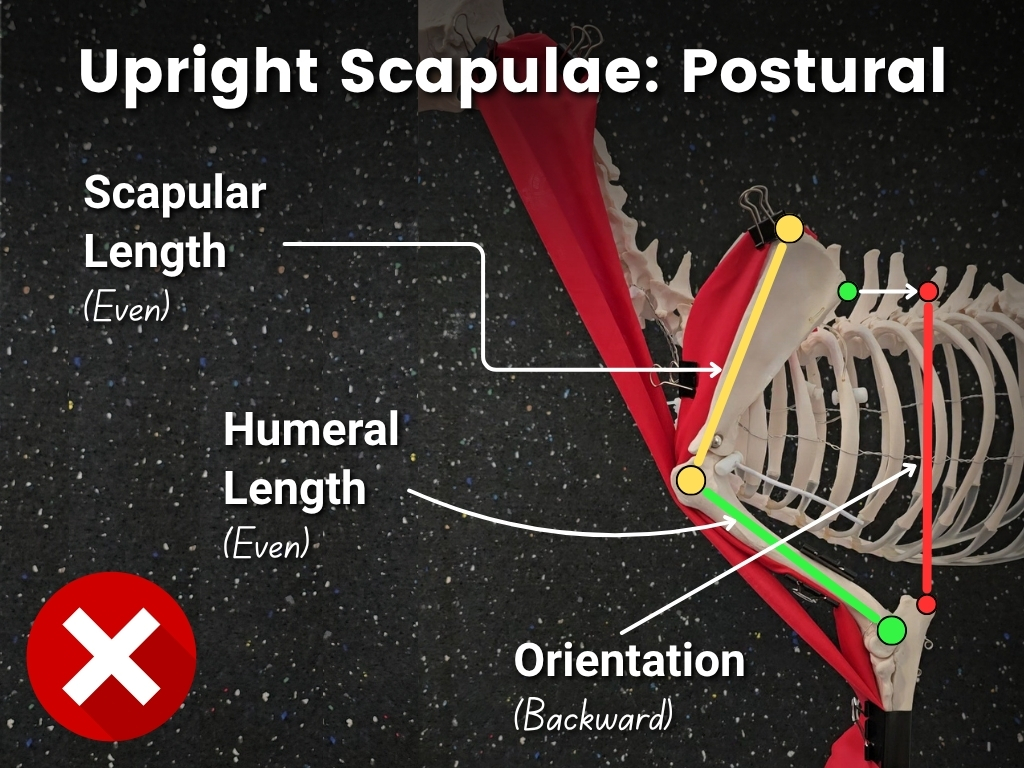
Characteristics:
- Even length between the scapula and humerus
- Unbalanced orientation
- Scapula pulled into forward rotation
- Olecranon oriented behind the caudal angle
This is an example of incorrect canine shoulder angulation caused by a hypertonic (dysfunctional) dorsal chain. Left unaddressed, the muscles in the cranial chain can also become hypertonic and weak as their normal range of motion is limited. This deviation is postural not structural and can be improved through targeted conditioning exercises sessions like Bow, Scapular Push Up, and Plank.
—
Short Humerus
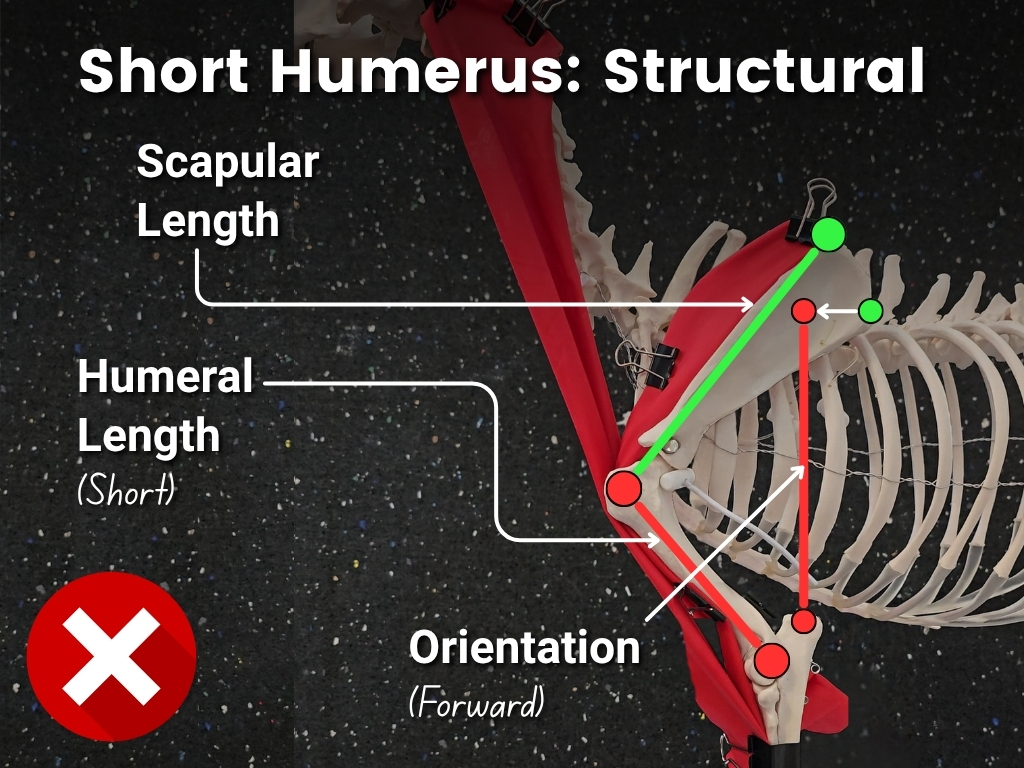
Characteristics
- Uneven length between the scapula and humerus
- Unbalanced orientation
- Scapula properly oriented
- Olecranon is well forward the caudal angle
This is the only true STRUCTURAL deviation affecting the canine shoulder, even though “lacking return of arm” or “short return of arm” seems to be blamed for everything.
This is an example of incorrect canine shoulder angulation caused by a short upper arm. Dogs with a short upper arm will have a shortened forelimb stride length, reduced ability to to absorb ground reaction force (impact force), and inefficient interaction between the cranial and caudal chains due to the change of the line of pull the foreshortened humerus creates.
—
Dwarf Breeds: An Interesting Consideration
The breed standard of most Dwarf Breeds calls for an intentional deviation from normal canine shoulder alignment. Dwarf Breeds are intentionally bred to express a genetic mutation in the FGF gene family called chondrodysplasia. The FGF variant causes the growth plates in the long bones to close prematurely, so they are unable to grow to normal length, and is also associated with intravertebral disc disease. This genetic variant is “semi-dominant” so inheriting one copy of the gene causes some limb shortening, while two copies result in maximal shortening.
While it is commonly repeated across the “dog fancy” world that this gene mutation allows for a more efficient head down position, this is simply not the case. A short humerus has a negative impact on canine shoulder angulation, and is always less efficient, and the FGF gene variant always comes with increased risk.
—
TL;DR
- Canine shoulder angulation is governed by two main components: Structure and Posture.
- Structure relates to bone length and shape.
- Posture relates to muscle tone, and the balance of tone between agonist and antagonist.
- Flaws in shoulder angulation can be caused by one or both components.
- Having a short humerus is actually pretty rare.
- What is often blamed as “poor return of arm” or “short upper arm” is much more likely a postural issue NOT a structural issue.
0 Comments