
Thoracic Hyperlordosis, or Swayback Posture, is a postural deviation in dogs caused by muscle imbalances in the thoracic sling. Ranging from mild (often erroneously attributed to the anticlinal vertebra) to severe, this condition can have significant biomechanical consequences, resulting in an unlevel spine, restricted scapular motion, and an increased risk of injury to the entire forelimb complex. Understanding and identifying these imbalances early is critical for maintaining your dog’s joint health and movement quality.
What is the Thoracic Sling
The thoracic sling is a complex system of muscles that work synergistically, to suspend the ribcage between the scapulae (shoulder blades). When these muscles are balanced, the ribcage and spine are supported in neutral alignment. This allows gravity force and ground reaction force (impact force) to be transmitted through the elbow and shoulder, and absorbed by the muscles of the thoracic sling, allowing for proper functioning of the front limbs and spine.
When the musculature of the thoracic sling becomes unbalanced, the ribcage is no longer suspended properly between the shoulder blades, resulting in thoracic hyperlordosis. When this Swayback Posture is present, scapular motion becomes restricted, and the joint kinematics in the shoulder and elbow are negatively impacted.
Movement flaws associated with Swayback Posture include…
- Reduced shoulder extension / reduced reach
- “Paddling” / thoracic limb circumduction
- “Hackney gait”
- Unlevel / concave spine alignment
- Poor cervical spine mobility
- Overall increased risk of injury to the forelimb assembly and thoracic spine.
Unlike humans, the canine skeleton lacks a collarbone, which means the thoracic limb (front leg) is attached to the axial skeleton (ribcage and spine) by muscles, tendons, and ligaments only. No bones. So the strength, and mobility of these muscles as a synergistic system is critical.
———
Muscles of the Thoracic Sling

There are four main muscle groups that make up the thoracic sling: the trapezius, rhomboid, serratus ventralis, and pectoralis (deep and superficial).
- Trapezius: The trapezius is a superficial muscle that runs from the dorsal spinous process to the spine of scapula on the outside aspect of the shoulder blade. The trapezius acts like a “lid” providing an upper limit to the motion and position of the ribcage within the scapulae. This is especially apparent when the dog is moving at speed (gallop) or decelerating rapidly.
- Rhomboid: The rhomboid lies deep to the trapezius, and has a similar action when functioning as part of the thoracic sling. But because the muscle structure contains a much more prominent cervical component, when out of balance, it can create an unnaturally upright scapular angle.
- Serratus Ventralis: The serratus ventralis is a large, fan shaped muscle that runs from the midpoint of the ribs upward to the underside of the scapula, and forms the “sidewalls” of the thoracic sling. It applies an upward force on the ribcage. It is the ONLY muscle that connects the ribcage directly to the scapulae. Its fan shape and individual finger-like attachment points on the individual ribs allows for the scapula to move through a full range, while simultaneously providing support and stability to the ribcage.
- Pectoralis (deep & superficial): The pectorals run from the sternum toward the top of the humerus and form the “floor” of the thoracic sling, providing an upward force on the ribcage.
———
Neutral Alignment
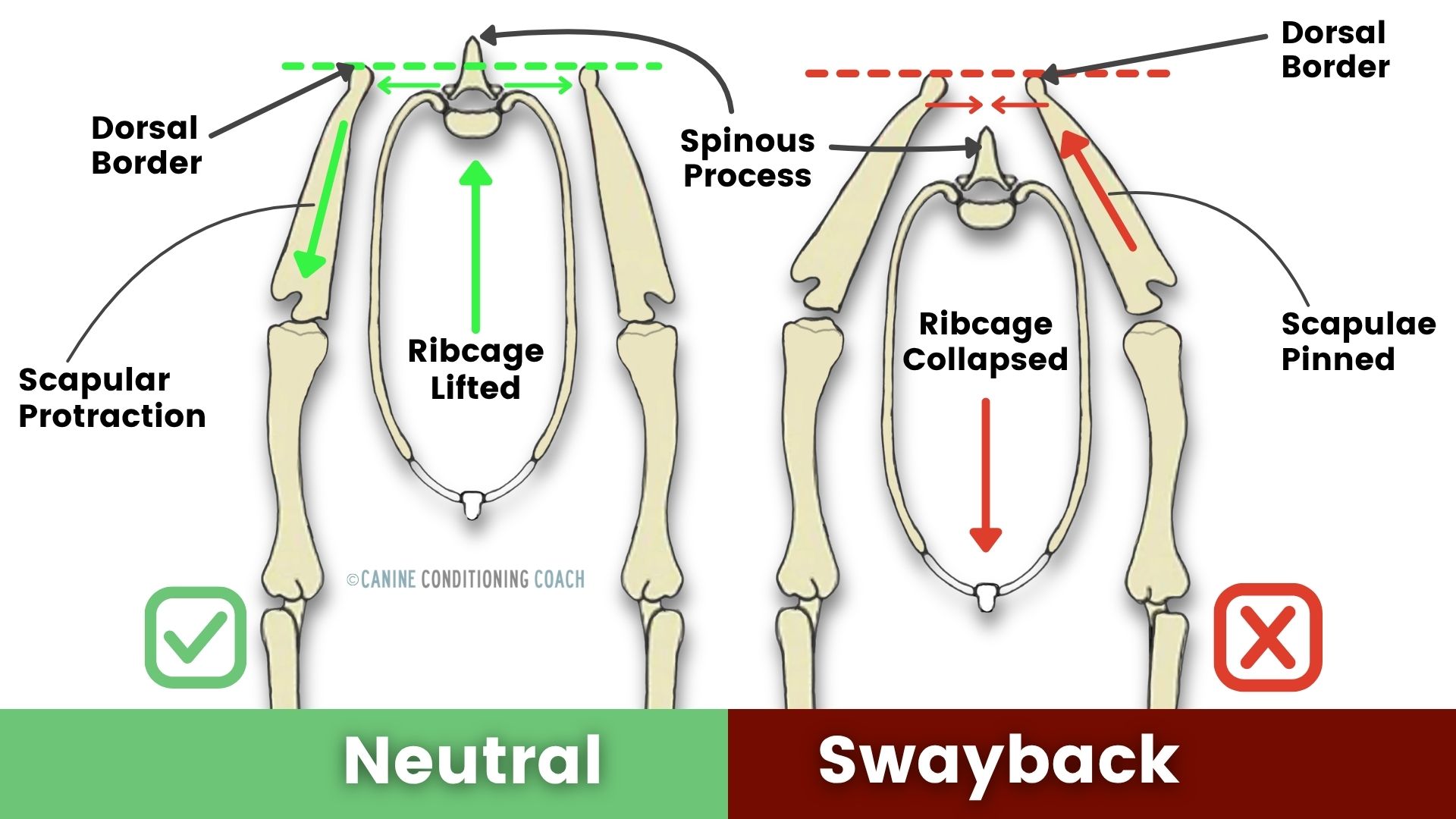
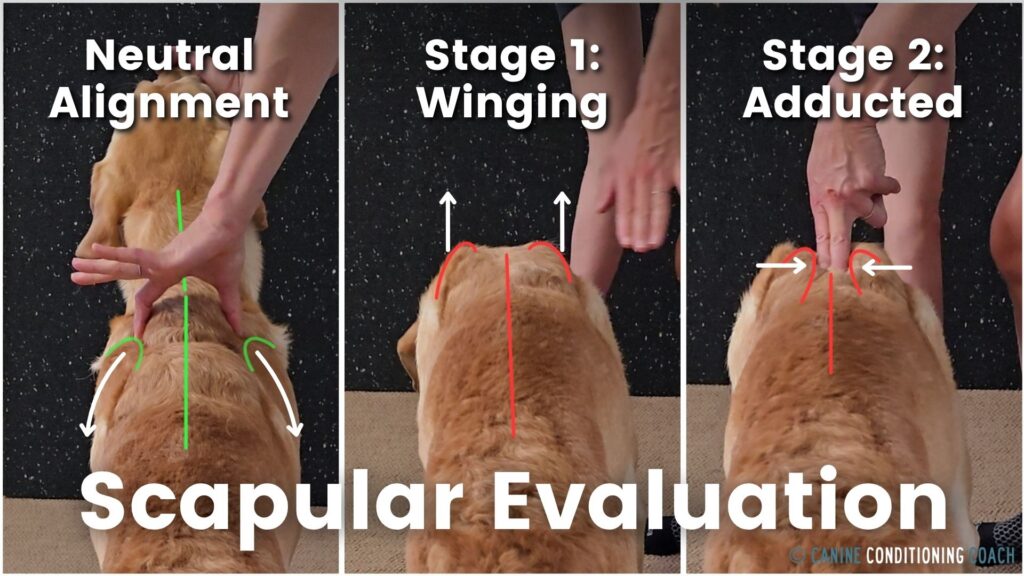
When the muscles of the thoracic sling are balanced, the ribcage is lifted, both scapulae are protracted toward the sternum, and the spinous processes are palpable above the dorsal border of the scapulae.
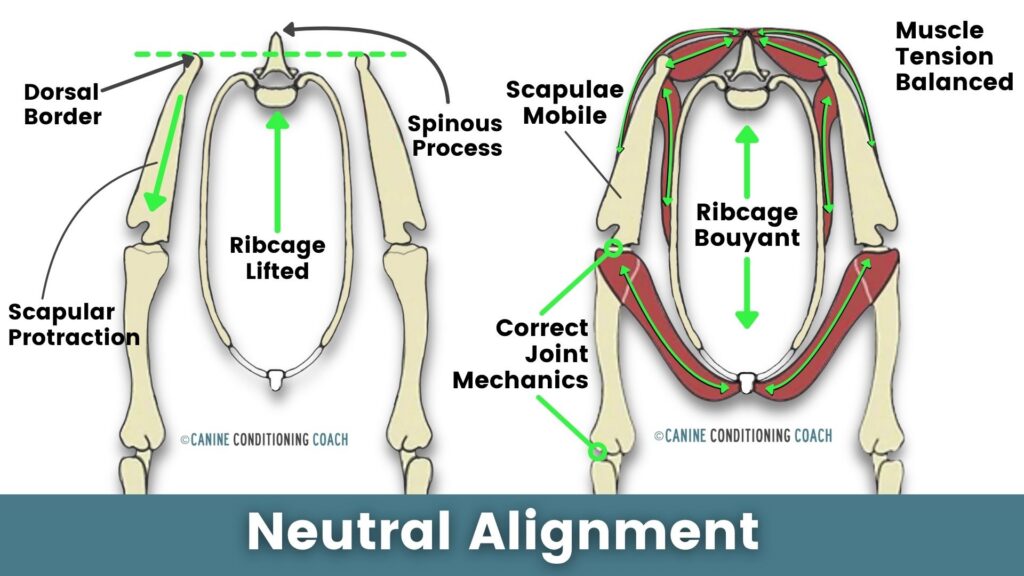
This results in a buoyant ribcage, mobile scapulae, and correct joint mechanics between the scapula and ribcage, as well as at the shoulder and elbow.
———
Thoracic Hyperlordosis Postural Deviation
When the musculature of the thoracic sling becomes imbalanced, we see a progressive deviation in the Swayback Posture, with the thoracic hyperlordosis and scapular misalignment becoming more severe over time.
Swayback Posture: Stage 1~ Winging Scapulae
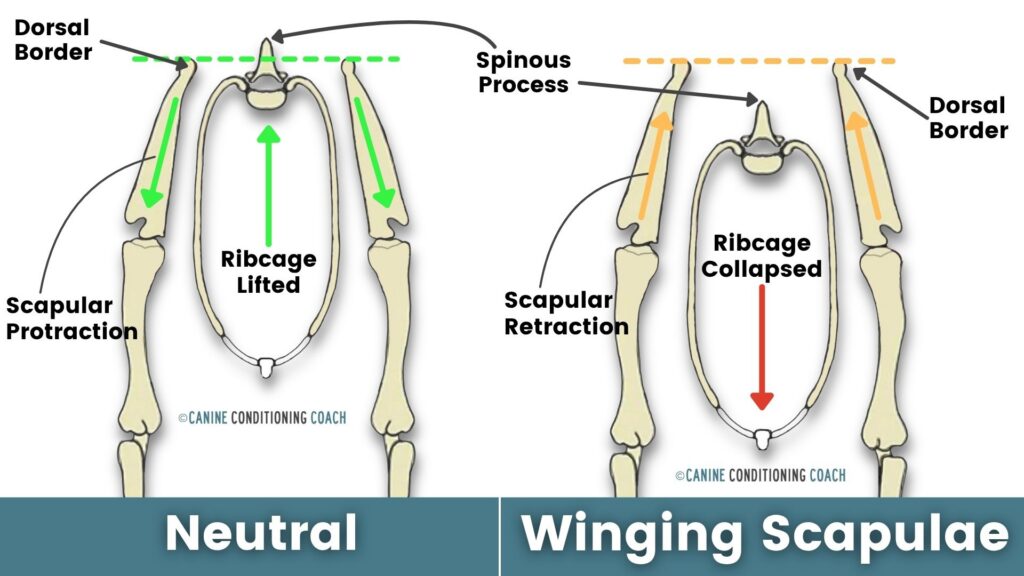
The first stage of Thoracic Hyperlordosis postural deviation is characterized by the ribcage collapsing downward, and the thoracic spinous process sitting below the dorsal border of the scapulae, this makes the scapulae more prominent, appearing like “wings” on the back… Hence Winging Scapulae.
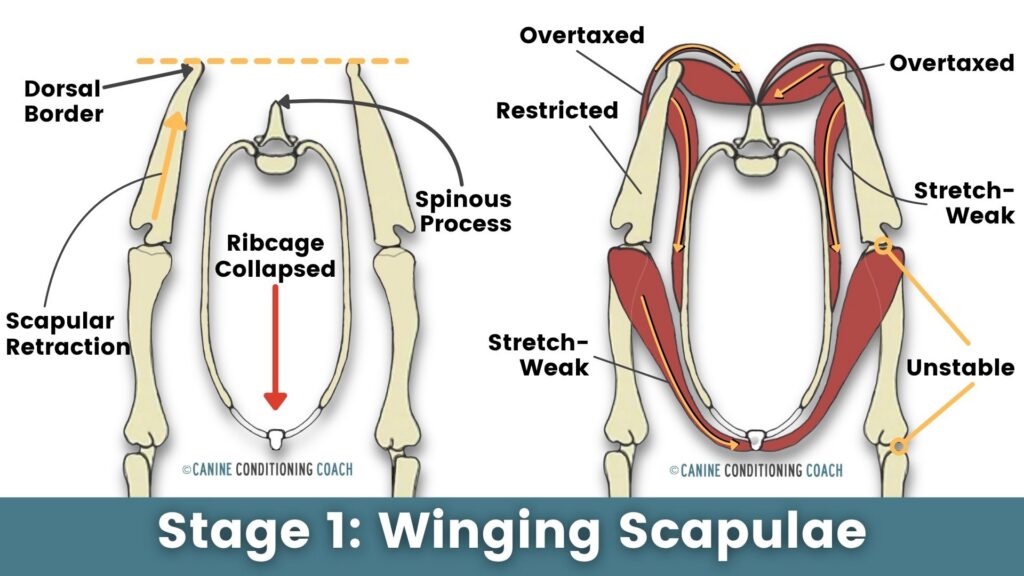
As the ribcage descends below the dorsal border of the scapulae the trapezius and rhomboids will become overtaxed, restricting the motion of the scapulae (hypomobility). Loaded in this inefficient position, the serratus ventralis and pectoralis become stretched out and weak, and can no longer provide support to the shoulder and elbow joints. For every area of hypomobility (scapula-ribcage-spine interface) an area of hypermobility is developed due to the Principle of Regional Interdependence. And hypermobility always increases injury risk.
This will often appear as a dip in the thoracic spine (thoracic hyperlordosis) just behind the withers with the dorsal border of the scapulae prominently displayed (winging).
Swayback Posture: Stage 2 ~ Adducted Scapulae

If the initial stage of Swayback Posture is left unaddressed, the trapezius and rhomboids will become hypertonic. This happens when muscles are forced to hold excessive, involuntary tension, in a chronically contracted state.

As a result of the hypertonicity, the scapulae will overly adduct, “pinning” the scapulae to the spine, even further restricting scapular motion. Then, the serratus ventralis and pectoralis are inhibited and further weakened due to the Principle of Reciprocal Inhibition. This leaves the shoulder vulnerable, and relying primarily on the glenohumeral ligaments, biceps and supraspinatus for shoulder stability, significantly increasing the risk of injury. This is especially true in high drive dogs, sport dogs, or working dogs that regularly engage in quick changes of direction, or rapid deceleration.
Dogs with this second stage progression of Swayback Posture will present with more significant thoracic hyperlordosis, and a non-prominant scapula as the scapular ridges are now covered by a tight, thick, hypertonic trapezius.
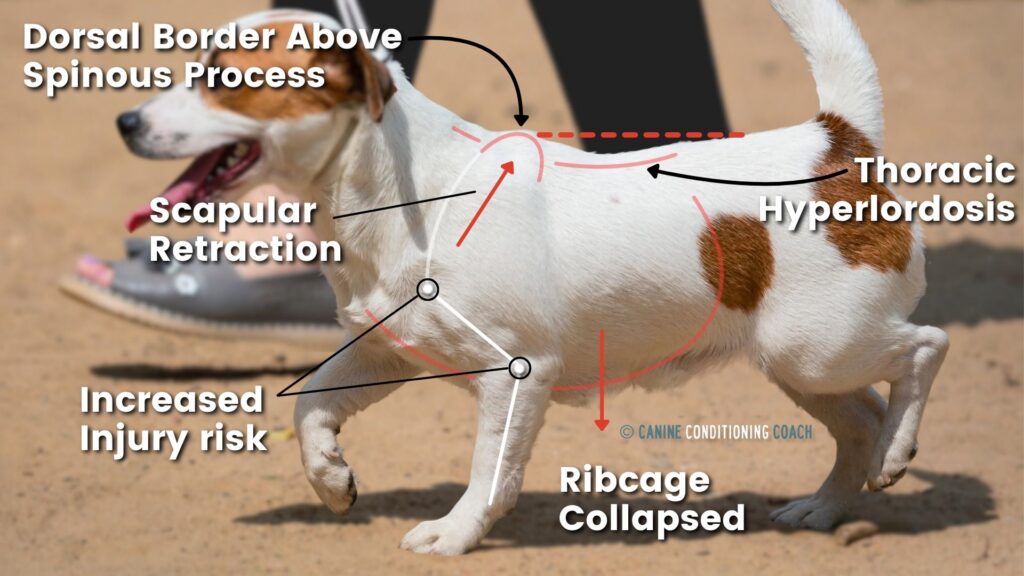
This can sometimes be mistaken for High in the Rear postural deviation. But if we draw a horizontal line from the dorsal border of the scapula to the dorsal iliac crest (as shown in the image above), we can see that the concavity (lordosis) in the thoracic spine is the pronounced deviation, not the convexity (kyphosis).
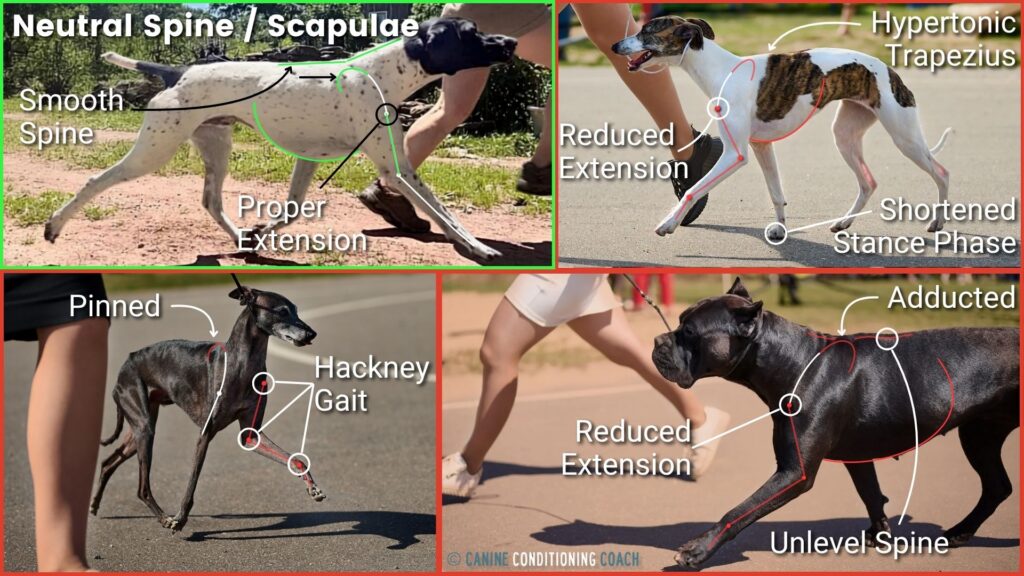
By this more chronic second stage progression of Swayback Posture, shoulder extension will often be significantly limited, as the scapula cannot properly rotate to allow the humerus to extend fully at the shoulder joint, resulting in all sorts of movement flaws through the thoracic limb.
———
But Scapular Retraction and Scapular Adduction are a normal part of Canine Locomotion!

True! Scapular retraction and scapular adduction ARE normal, and necessary when the head is dropped, or a dog is working low to the ground. The difference between normal scapular retraction and a postural deviation lies in the underlying muscle balance, and the ability of the dog to execute neutral spine posture when asked. When a dog returns to a Stand, the scapulae should protract back into neutral position, and the thoracic hyperlordosis should disappear.
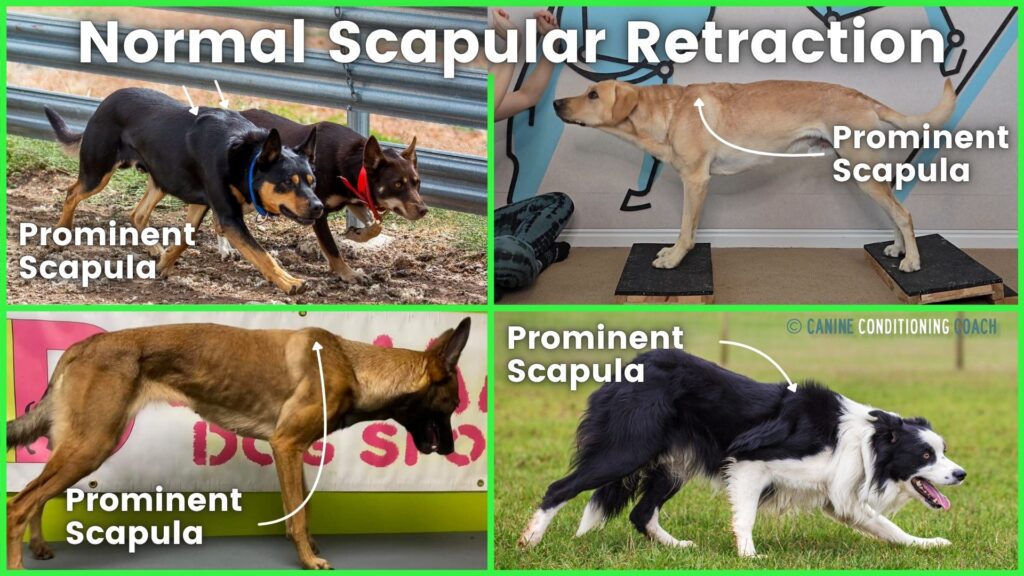
Dogs with good muscle balance through the thoracic sling will always display a prominent scapula during head down work (as the trapezius is not hypertonic), and when they return to a standing position the thoracic sling should re-engage bringing the ribcage and scapulae back into neutral position, with the spinous process above the dorsal ridge. This is true across breeds and type. In comparison, dogs with Swayback Posture will be unable to easily transition to neutral spine and proper scapular alignment.
———
What about the Anticlinal Vertebra?
There is a lot of mythology around the anticlinal vertebra, and it is often cited (erroneously) as an acceptable reason why the spine might be lordotic (concave). And this is simply not the case.

The anticlinal vertebra usually occurs at T11, and includes a truncated, triangular shaped spinous process that lies vertical to its vertebral body. This adaptation allows space for the mid-thoracic spine to extend, without the spinous processes running into each other, improving the functional mobility of the canine spine. The supraspinous ligament, which runs from the skull (technically it originates as the nuchal ligament), along the spinous process to the pelvis, with the truncated spinous process of the anticlinal vertebra sitting immediately below this ligament.

On top of this ligament lies the large muscles of the intermediate layer (longissimus system), and the still LARGER muscles of the superficial layer (iliocostalis system). Along with these intermediate and superficial muscles systems, the thoracolumbar fascia and the subcutaneous fat layer all lay on top of the supraspinous ligament, concealing any small dip caused by the truncated spinous process of the anticlinal vertebra. It’s just covered by too much stuff!!
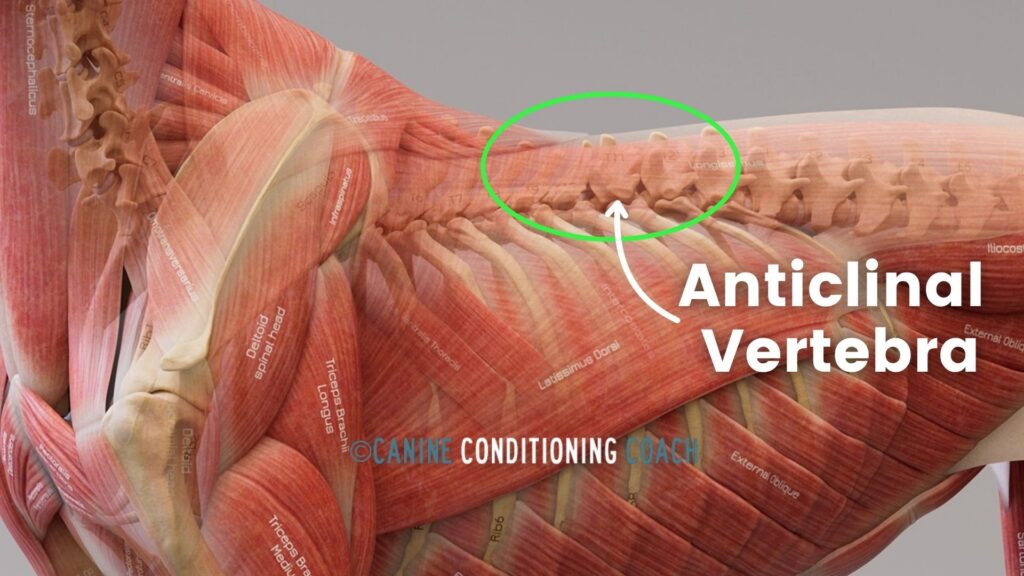
So except in cases of muscle wasting due to malnutrition, or neuropathic muscle atrophy, the anticlinal vertebra has nothing to do with spine misalignment, Swayback Posture, or thoracic hyperlordosis.
Want to learn more about the actual function of the anticlinal vertebra, why it’s missing a tall spinous process, and what a dip in your dog’s backline actually means? Check out this blog post Canine Anticlinal Vertebra: Facts not Fiction.
———
How to assess your dog for Swayback Posture
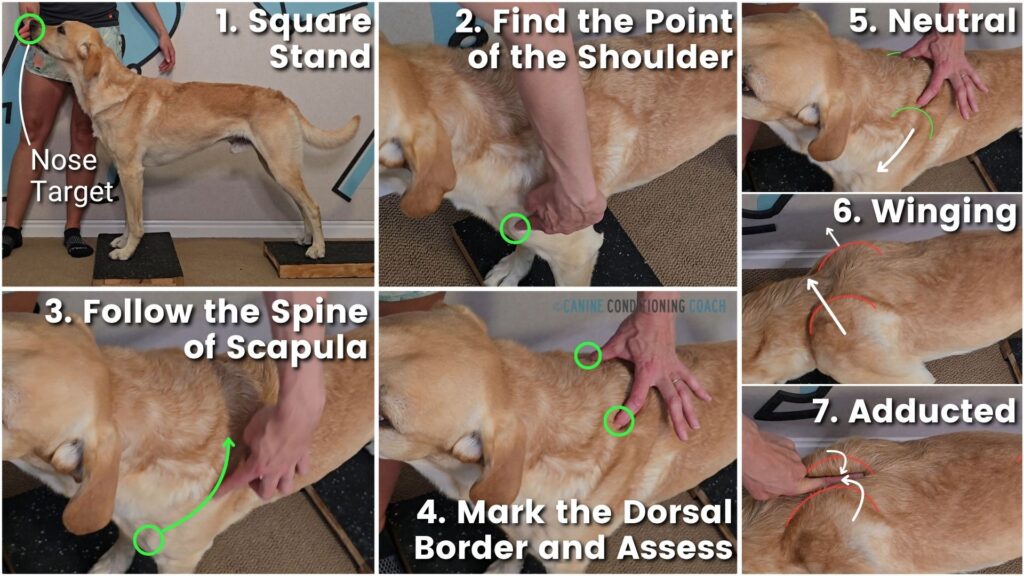
- Position your dog in a Square Stand, using foot targets if that helps provide context for your dog. Use a chin rest, nose target, Manners Minder, or a helper to maintain a neutral head and neck position.
- Find the point of the shoulder
- Follow the spine of scapula up to the dorsal border.
- With your fingers mark the dorsal border and assess.
- Does the dorsal border fall below the spinous process, with the scapulae broadly separated? If yes, congratulations! Your dog’s thoracic sling is well balanced.
- Do the scapulae appear to protrude above the top of the spine? If yes, check for a gap between the shoulder blades. A wide gap indicates Stage 1: Winging Scapulae.
- If there is only a small gap, or no gap and the scapulae are pinned together, this indicates a progression to Stage 2: Adducted Scapulae.
———
From Assessment to Intervention: Addressing the Thoracic Sling
You now have the tools to accurately assess your dog’s posture and identify both the subtle and not so subtle signs of thoracic hyperlordosis. But assessment is only the starting point. The real progress comes from the systematic rebalancing of the thoracic sling.
The biomechanical consequences we discussed, such as restricted scapular motion, compensatory gait mechanics, and an overall increased injury risk, need to be addressed, and the solution lies in targeting the serratus ventralis, trapezius, pectorals, and rhomboids to restore neutral spine and scapular alignment.
I have laid out the targeted exercise protocol for you in Exercises to Improve Canine Spine Alignment: Rebalancing the Thoracic Sling, including all the necessary equipment, starting setup, reps and sets, and suggested progression. Let’s go!
0 Comments