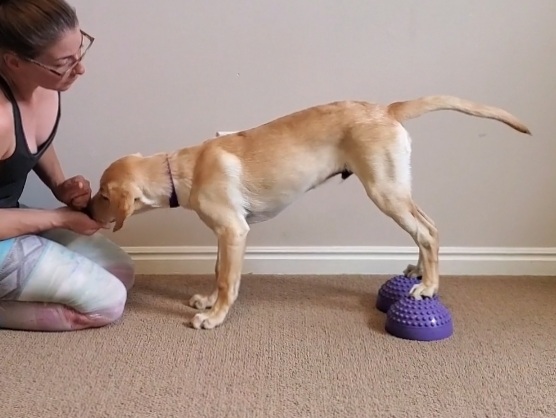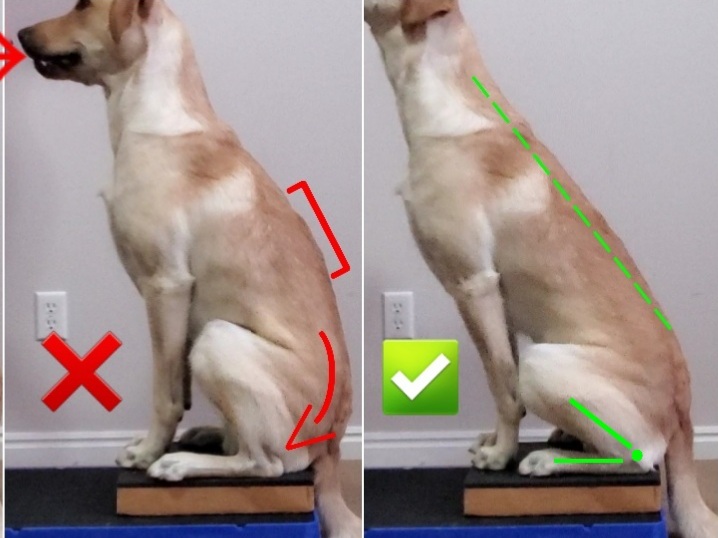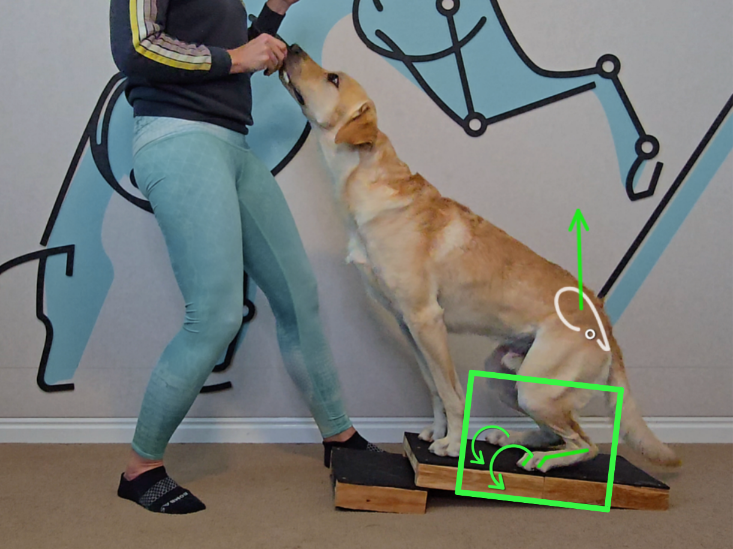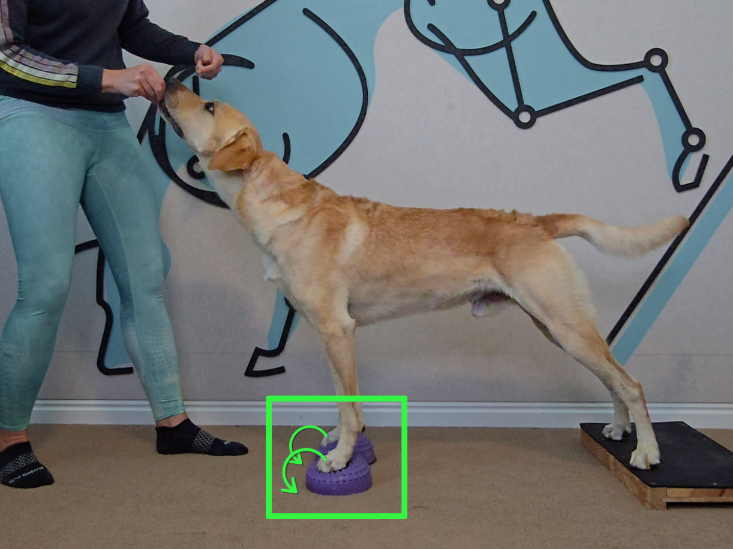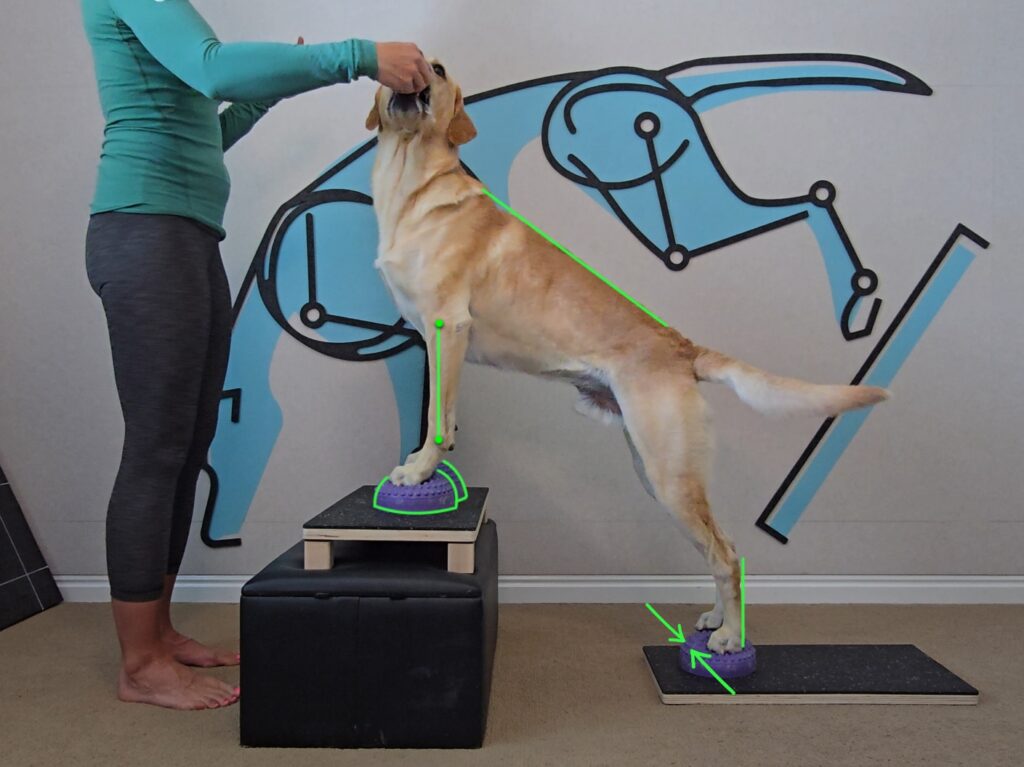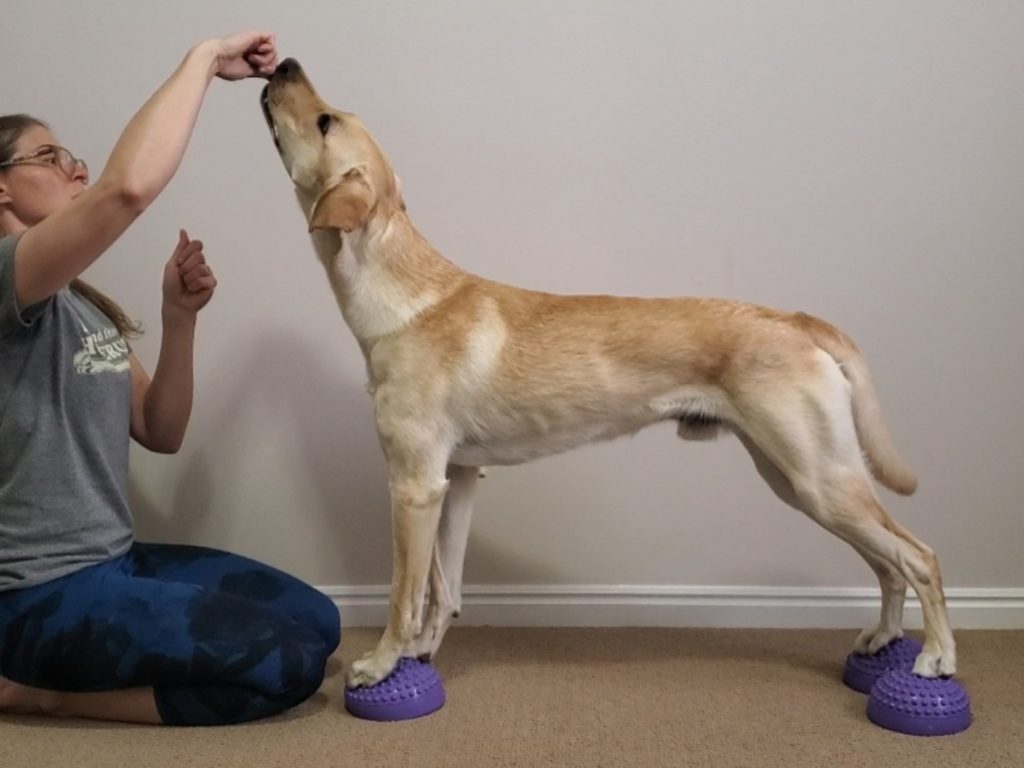
Purpose: Quarter Sit – Front Focus builds on the behavior learned in beginner level variation and incorporates Paw Pods under the front feet. This allows us to target the musculature that supports proper alignment of the digits (toes), metacarpals (pasterns), and carpus (wrist). This exercise is especially important for young dogs, senior dog, sport dogs, and dogs demonstrating postural deviation in the front end including Flat Feet, Rolling Off the Toe Pads, Splayed Feet, and laxity through the pasterns.
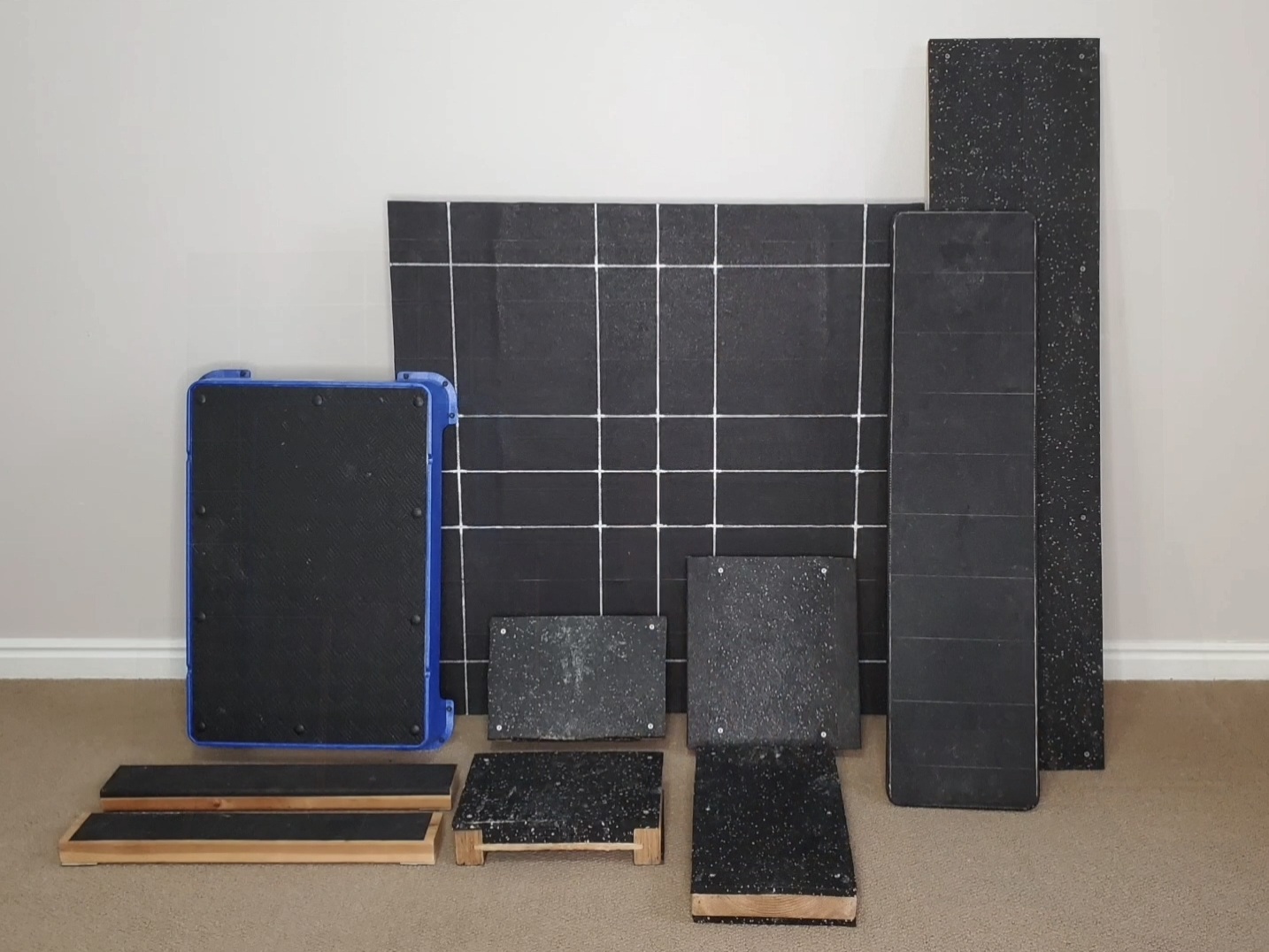
Equipment: 2 Foot Targets, 1 Sitting Platform, and 2 Paw Pods
Targets: Deep / Superficial Digital Flexors, and Interossei in the front limbs.
NOTE: Best practice is to introduce this Quarter Sit behavior in the simpler beginner level variation, even if your pup does not need a specific focus on the rear foot flexors. This ensures we are not introducing too many skills at the same time, and is a better example of splitting vs lumping. Additionally, if your pup has not been introduced to Paw Pods, it will be important to work through the Intro to Paw Pods, and / or the Introducing One Pod video tutorial first before attempting this exercise.
Watchpoints:
- Ensure a completely stable, non-slip surface is used. If your pup is sliding backward on the Sitting Platform, the challenge will likely shift from the rear feet to the shoulder muscles (latissimus and triceps), nullifying the exercise’s purpose.
- If your pup is struggling with placing the front feet on the Paw Pods, start in a Stand position, get the front feet organized on the Paw Pods, and then use your Tuck Sit cue to initiate the Sit. Alternatively, revisiting the Intro to Paw Pods, and / or the Introducing One Pod video tutorial might be helpful.
- We will use a combination of Placement of Reward and Handler Motion to cue / support the Quarter Sit behavior. Using Placement of Reward alone will likely be insufficient, so make sure your torso is moving, as detailed in the video.
- We should see the toes actively adducting toward the midline of the foot during the Weight Shift Forward Phase. If we’re not seeing this happen, your Placement of Reward may be too low, and mistakenly encouraging elbow/shoulder flexion instead of digit flexion.
- I mark in the Quarter Sit position, but deliver the reward once the dog returns to the Sit. This prevents unintentional rewarding the full transition to stand. Consider your dog’s individual needs and the parameters for your training system, as this will not work for all dogs.
- Do NOT use a verbal Stand cue to initiate this behavior, as we do NOT want a full transition to Stand. Placement of Reward plus Handler Motion, and good marker timing should be enough to capture this behavior. (However, if your training system is very verbal forward, of course you can add a verbal after the behavior is trained).