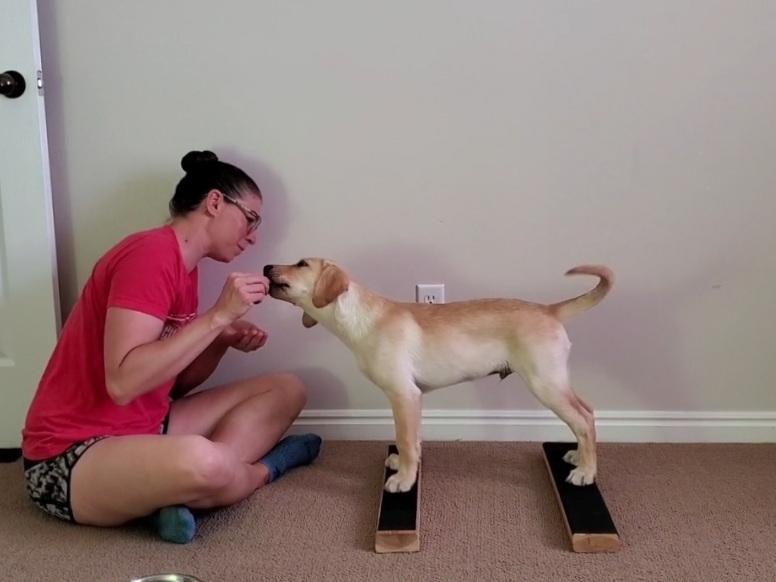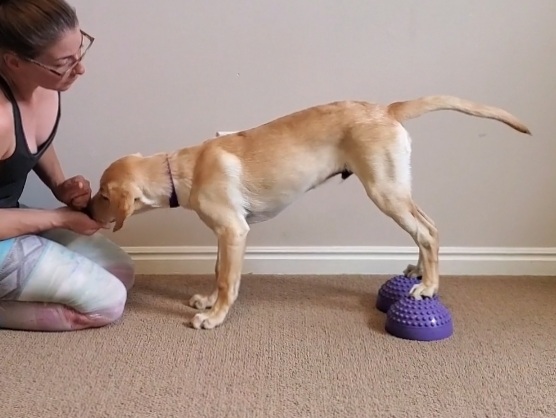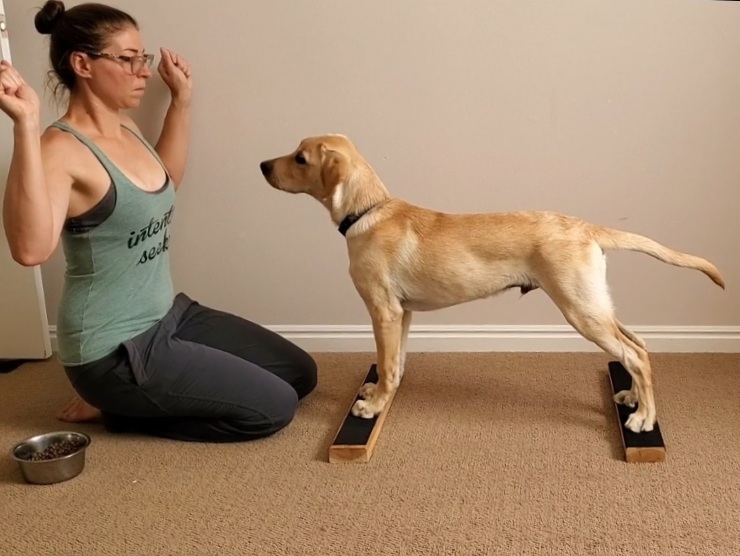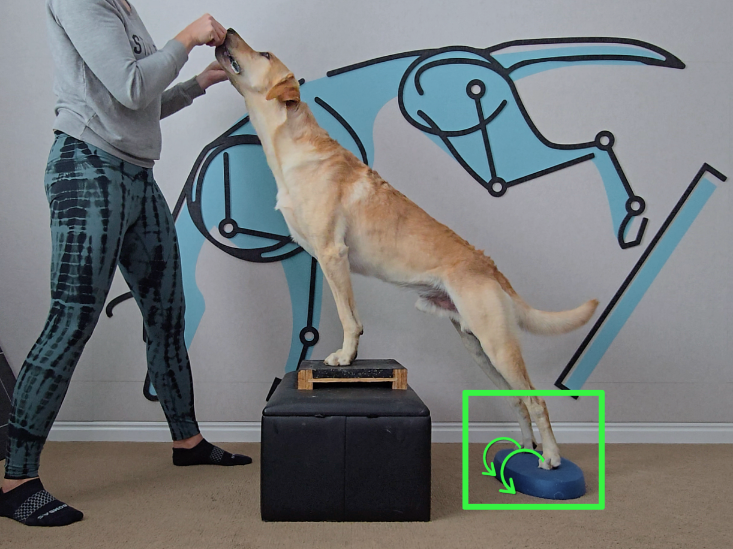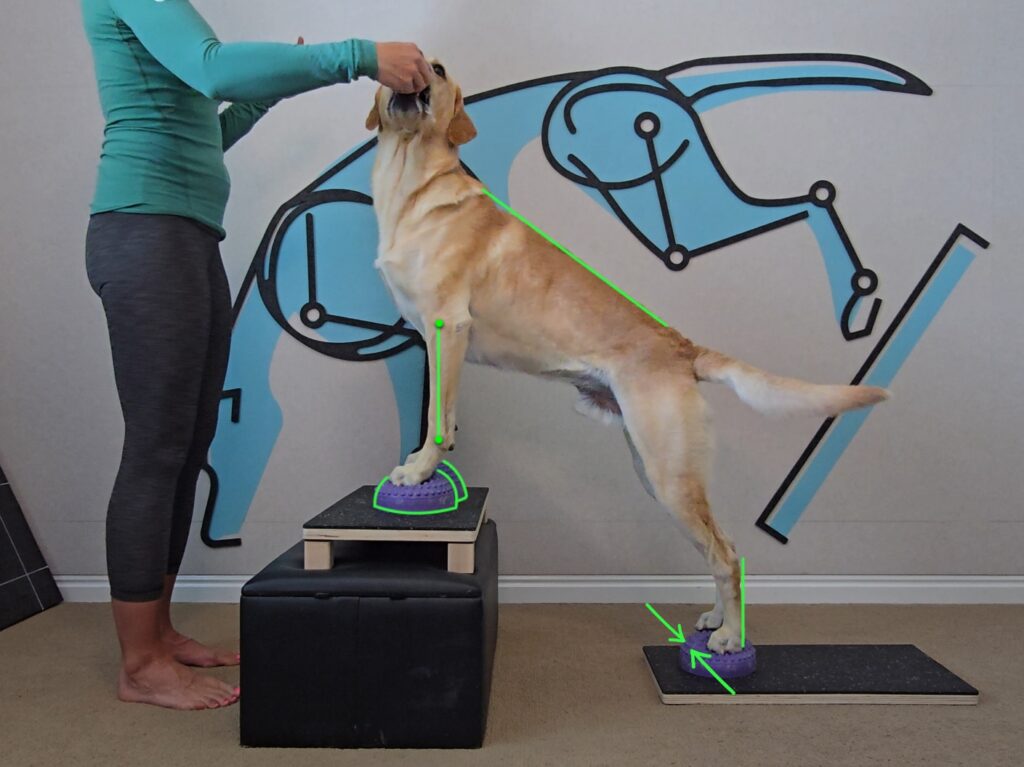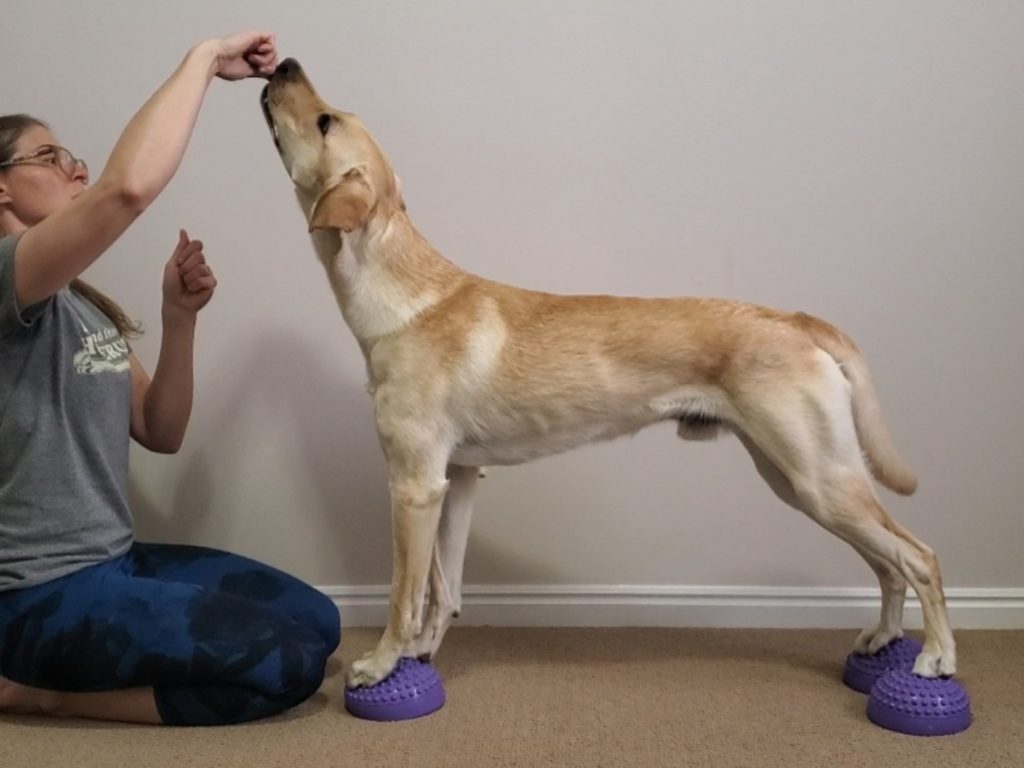

Purpose: Metacarpal Stand is a targeted exercise used to build strength and stability in the musculature that supports the digits (toes), metacarpals (pasterns) and carpus (wrist) in the forelimbs. Building strength and stability through the lower forelimb reduces the risk of impact related injury to the elbow and shoulder. Metacarpal Stand can also be used to help improve postural deviations like Flat Feet, Rolling Off the Toe Pads, Splayed Feet, and Carpal Laity (weak pasterns) affecting the thoracic limbs.
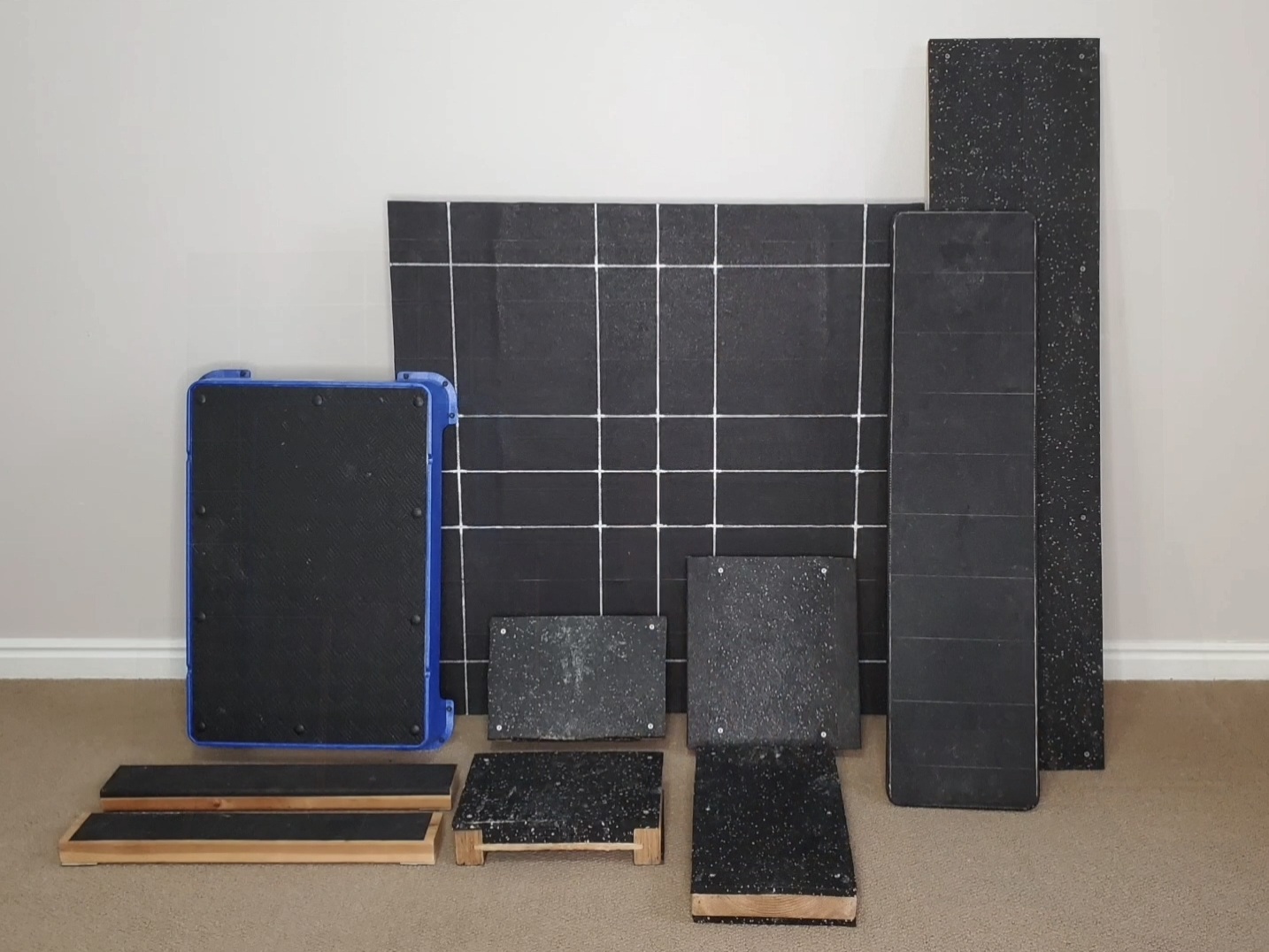
Equipment: 1 Foot Target or Sitting Platform, and 2 Paw Pods or Balance Pad
Targets: Deep / Superficial Digital flexors, and Interossei in the front limbs.
NOTE: Paw Pods are my preferred piece of equipment for individuals dealing with Flat Feet, Rolling Off the Toe Pads, or Splay Foot postural deviation. The domed surface encourages proper lifting of the metatarsophalangeal joint (upper most toe joint), and promotes proper muscle recruitment. A Balance Pad can be used if that’s all you have available, or if this exercise is being used for general strengthening / prevention. If your dog is not familiar with Paw Pods, you might find the Intro to Paw Pods video tutorial helpful.
Watchpoints:
- Prop Setup should be such that the dog starts in a slightly shortened Stand. This ensures we are not overloading the core muscles or iliopsoas, and allows us to focus on properly recruiting the small musculature in the feet.
- We want to use a stable compliant surface. This means the surface is soft, but the base should be stable in the interface with the ground. We do NOT want to use an unstable prop, as that will make the exercise too difficult for this phase of development, and we won’t actually be targeting the intended musculature.
- We’ll use a combination of Handler Motion and Placement of Reward to cue the Forward Weight Shift behavior.
- Keep an eye on the front feet. We are looking to see the toe muscles contract, the front of the toe pads become load bearing, and the toes adduct toward the midline of the foot. This is actually the behavior we want to mark and reward.
- The digital flexors and interossei are small muscles that are often weak (especially if your pup is demonstrating a postural deviation). It’s important to undershoot the fatigue threshold of these weakest muscles. If you are no longer able to see the toes contracting properly, stop. The foot muscles are likely fatigued aren’t being recruited properly.
- Any change in behavior, or avoidance should be seen as fatigue NOT DISOBEDIENCE. This exercise is very challenging on the foot muscles.